

Flies
Musca domestica
Disease-carrying and relentless — house flies contaminate everything they touch.
"Your pest problem
is our business"
is our business"
- RainCity Pest Control -
Pest problems in Flies? Raincity can help!
Proudly Canadian
Pet Friendly
Flies
Overview
House flies are one of the most common and medically significant pest insects found in BC homes and businesses. Capable of reproducing rapidly in warm conditions, a single female can lay up to 500 eggs over her lifetime, with larvae reaching maturity in as little as 7 to 10 days under ideal conditions. House flies…
House flies are one of the most common and medically significant pest insects found in BC homes and businesses. Capable of reproducing rapidly in warm conditions, a single female can lay up to 500 eggs over her lifetime, with larvae reaching maturity in as little as 7 to 10 days under ideal conditions.
House flies breed in a wide range of organic waste — including compost, garbage bins, floor drains, pet waste, and rotting food — making infestations difficult to eliminate without identifying and treating the source directly. Adult flies do not bite but pose a serious public health risk through the mechanical transmission of bacteria and pathogens picked up from contaminated surfaces.
Professional treatment is essential for persistent or large-scale infestations, particularly in food handling environments where health code compliance is required.
Get a free Quote. Give us a call.
236.521.8668


Raincity
Risk Index
Our Risk Index breaks down each pest's threat level so you know exactly what you're dealing with and how urgently to act.
Risks: Flies
Property
Damage
3 / 10
Nuisance
Level
4 / 10
Health
Threat
8 / 10Structural & Material
Noise & Disruption
Bite & Disease Exposure
What This Means For You
House flies cause no direct structural damage but readily contaminate stored food products, leading to spoilage and financial loss. In commercial food service or hospitality settings, a visible fly infestation can result in failed health inspections, regulatory fines, and serious reputational damage.
Detail
House fly populations are highly disruptive in both residential and commercial environments. Persistent presence around food preparation areas, constant movement, and visible swarms create significant discomfort for occupants and can deter customers in restaurants, cafes, and retail food settings.
House flies are one of the most significant disease-carrying insects in urban environments. They breed and feed on decaying organic matter, animal waste, and garbage, then land directly on food and food preparation surfaces. They are known vectors for Salmonella, E. coli, Listeria, Typhoid, and more than 65 other pathogens. Transmission occurs through direct contact, regurgitation, and fecal deposits left on surfaces.
Know Your Pest
Flies Knowledge, Prevention Tips & Home Protection Advice.
Facts: Flies
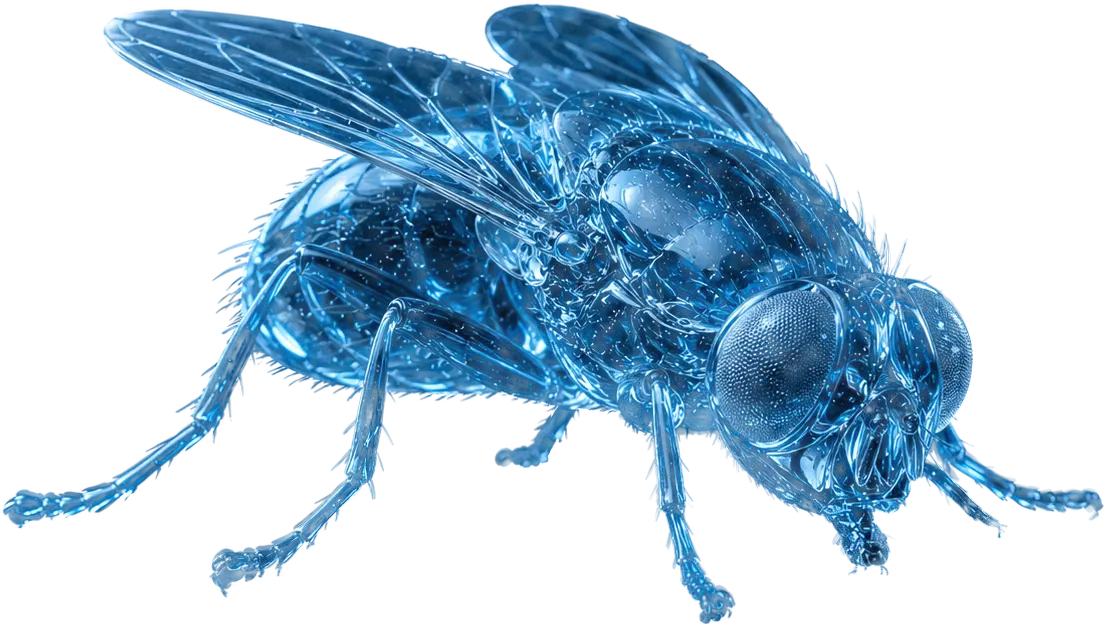
Grey-bodied with four dark stripes on the thorax, large red compound eyes, and a single pair of wings. Adults measure 6–7mm in length. Larvae (maggots) are pale white, legless, and taper to a point at the head end.
House flies do not chew or bite — they feed by liquefying food using regurgitated saliva, then consuming the resulting liquid. They feed on a wide range of organic matter including human food, animal waste, garbage, carrion, and decaying plant material.
Breeding Females lay batches of 75–150 eggs directly onto moist organic matter such as garbage, animal feces, compost, or rotting food. Eggs hatch within 12–24 hours. Larvae pass through three instars before pupating, with the full egg-to-adult cycle completing in as little as 7–10 days in warm conditions. A single female can produce up to 500 eggs in her lifetime, making populations capable of explosive growth during summer months.
Summer
Spring
Fall
Winter
House fly infestations are almost always a symptom of an unresolved sanitation or structural issue rather than a standalone pest problem. Experienced technicians look beyond the adult population and focus on locating cryptic breeding sites — particularly floor drains with organic buildup, poorly sealed waste containers, and gaps in building envelope that allow entry from external sources. In commercial settings, a thorough inspection of receiving areas, grease traps, and recycling storage is essential. Treatment without a full source audit rarely delivers lasting results, and recurring infestations are a strong indicator that a contributing condition has been missed.
Keep garbage bins tightly sealed and emptied frequently. Clean floor drains and organic waste areas regularly. Ensure all window screens and door seals are intact. Remove pet waste promptly and eliminate any standing water or decomposing organic material around the property where flies can breed.
High. House flies pose a genuine public health risk and should not be dismissed as a minor nuisance. Their feeding and breeding behaviour brings them into direct contact with pathogen-rich environments — animal waste, rotting organic matter, and garbage — before they land on food, utensils, and preparation surfaces in your home or business. Unlike biting insects, harm occurs invisibly through contact, regurgitation, and fecal deposits, with no indication that contamination has taken place. The risk is significantly elevated in households with young children, elderly residents, or immunocompromised individuals, and in commercial food service settings even a low-level fly presence represents a health code violation and a liability risk.
Over-the-counter sprays, sticky traps, and electric zappers can reduce adult fly numbers temporarily but do nothing to address the breeding source. Without locating and treating the sites where larvae are actively developing — floor drains, garbage areas, compost bins, or hidden organic buildup — the infestation will continue to cycle no matter how many adults are eliminated. Misidentifying the source is the most common DIY failure point, as flies often breed far from where adults are most visible. Repeated use of consumer insecticides in food preparation areas also poses health risks, particularly for households with children, pets, or anyone with respiratory sensitivities.
RainCity technicians identify and treat fly breeding sites at the source rather than targeting only the adult population. This approach breaks the reproductive cycle and delivers lasting control that over-the-counter sprays cannot achieve.
Larvicide treatment at breeding sites, residual insecticide application, fly light traps for adult monitoring and capture, and exclusion measures to prevent re-entry.
A comprehensive house fly control program includes breeding site identification, larval treatment, adult population reduction using professional-grade products, and a tailored set of recommendations to eliminate the conditions that allowed the infestation to establish.
Signs of Activity
Early detection prevents small issues from becoming full infestations. Watch for signs in hidden or undisturbed areas.
Maggots
Larvae visible in garbage bins, compost, floor drains, or around pet waste areas confirm active breeding is occurring nearby.
Fly Specks
Small dark spots of fecal matter deposited on walls, windows, light fixtures, and food preparation surfaces indicate a sustained fly presence.
Egg Clusters
Small white masses found in moist organic material such as rotting food, soil, or waste containers signal that breeding conditions are present.
Clustering Near Light Sources
Persistent grouping around windows, skylights, and light fixtures — particularly in the morning — indicates flies are entering from outside or emerging from an indoor breeding site.
Drain or Waste Odour
An unusually strong odour from floor drains or concealed waste areas can indicate organic buildup significant enough to support fly breeding.
Frequently Asked Questions
Find expert answers to our most common questions and discover how we keep your home or business pest-free.
Flies are attracted to food, moisture, and organic waste. If you are seeing them regularly indoors, there is likely a breeding source nearby — a drain with organic buildup, an unsealed garbage bin, rotting food, or pet waste. Addressing the source is the only way to resolve a recurring fly problem.
Yes. House flies are mechanical vectors for more than 65 pathogens including Salmonella, E. coli, and Listeria. They pick up bacteria from waste and contaminated surfaces and transfer them directly to food and food preparation areas through contact, regurgitation, and fecal deposits.
House flies can breed in surprisingly small amounts of organic material. A slow floor drain, an unnoticed spill behind an appliance, or a compost bin with a loose lid can be enough to sustain an infestation. An inspection by a pest professional can identify sources that are not immediately visible.
Very quickly. Under warm conditions a single female can lay up to 500 eggs in her lifetime, with the full egg-to-adult cycle completing in as little as 7 to 10 days. An untreated infestation can escalate significantly within a few weeks during summer months.
Consumer sprays and traps can reduce adult numbers temporarily but rarely resolve the infestation because they do not address the breeding source. Professional treatment targets the full life cycle — larvae, pupae, and adults — and includes a source audit to eliminate the conditions driving the problem.
House flies enter through gaps around doors and windows, damaged screens, open vents, and utility penetrations. They are also commonly introduced through open doors in commercial settings. Exclusion measures combined with source elimination are the most effective long-term solution.
Occasional flies entering from outside are normal. An infestation is indicated by consistent daily sightings, flies congregating in the same areas repeatedly, visible maggots or fly specks, or flies present throughout the year including in cooler months — which suggests an indoor breeding source.
Ready to Get Rid of Flies?
Let our professional team protect your home or business with proven solutions that work.
Schedule an inspection
- Local, licensed & Insured
- Fast Response & Reliable Service
- Satisfaction Guaranteed